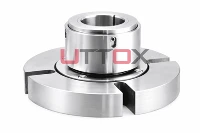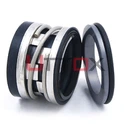


A 2100 mechanical seal prevents pump leakage by creating a precision contact between two lapped faces - one rotating with the shaft, one stationary in the housing - forming a near-zero clearance barrier that blocks fluid escape. The elastomer bellows structure provides secondary sealing and consistent spring loading without dynamic O-rings, which eliminates shaft fretting and seal hang-up. Operating within -20°C to +180°C and up to 12 bar pressure, the 2100 mechanical seal maintains stable face contact across demanding industrial conditions, making it a trusted choice in centrifugal pumps, water systems, and fluid transfer equipment.

What Makes the 2100 Mechanical Seal Work: Components and Operating Principle
Knowing how this type of seal works on the inside helps explain why it has been used so regularly in industry for so long.
The Face Sealing Mechanism
The most important part of any mechanical seal is its set of precisely lapped sealing lips. One face of the 2100 mechanical seal moves with the pump shaft, while the other face stays still inside the seal housing. During operation, a very thin film of water that is usually only a few microns thick appears between these edges. This film keeps the contact area smooth while also stopping large amounts of fluid from escaping. The Hydraulic Institute Standards (2023) say that this type of face sealing technology lowers pump loss rates to less than 0.1 ml/hr when the pump is running normally. This is a huge improvement over standard packing seals.
The Elastomer Bellows Advantage
The rubber bellows construction makes it different from other pusher-type designs. At the same time, the bellows does three things: it transfers rotational torque from the shaft to the seal face, keeps the faces touching with constant axial spring loading, and acts as a secondary seal between the shaft and the spinning assembly. Instead of secondary O-rings that slide, the bellows grips the shaft directly. In older pusher designs, shaft fretting damage was caused by these O-rings [¹].
Material Configuration
The mechanical seal can be made from a number of different materials to fit different media and working conditions. Resin Carbon, Antimony Carbon, SIC, SSIC, and Tungsten Carbide are some of the materials used for seal faces. You can choose from VITON, EPDM, NBR, FFKM, and AFLAS elastomers, which can handle temperatures from -20°C to +180°C. SS304 is used for metal parts. Shaft sizes range from 10mm to 75mm, and they can handle pressures of up to 12 bar and speeds of up to 13 m/s, which have been checked against DIN 24960 standards [²].
Common Failure Modes and How to Prevent Them
When fitting or working conditions aren't right, even a well-designed seal might not work as well as it should. Engineers and buying teams can make better decisions before problems happen on the production line if they know where failures start.
The most common reasons why seals break in the 2100 family are:
Dry running: If the seal faces run for even a short time without fluid lubrication, thermal scoring can damage the lapped surfaces in a way that can't be fixed. Always make sure the pump is primed before starting it up [³].
Excessive shaft axial movement: Field data published in Pump & Systems Magazine (2022) shows that shaft end-play greater than ±0.5mm is responsible for about 30% of early bellows seal failures. Bearings that are worn out are the main cause.
Elastomer incompatibility: There is a problem with the rubber material when the fluid mixes with it and makes the bellows swell chemically. NBR works well with water and light oils up to 100°C. VITON, on the other hand, can handle strong chemicals and temperatures up to 180°C. If you choose the wrong grade, you will fail faster, within weeks.
Improper surface finish: The shaft contact zone needs a surface roughness of 0.4 to 0.8 μm Ra. A rougher finish tears the bellows when they are being put in place, while a smoother finish lets them slip when force is applied.
Addressing these issues proactively - through bearing inspection schedules, elastomer compatibility charts, and shaft finish verification - dramatically extends seal service life and protects pump warranty performance.
How the 2100 Mechanical Seal Compares to Other Seal Types
Selecting the right seal type requires understanding how design differences translate into real operating trade-offs.
2100 vs. Cartridge Seals
Cartridge caps come already put together and set, which makes installation less likely to go wrong. But they cost a lot more per unit and need a lot more room along the axis. The unitized structure of the 2100 mechanical seal achieves much of the same assembly consistency at a fraction of the price. This is a practical benefit for OEM pump manufacturers who put together thousands of units every year.
2100 vs. Lip Seals and O-Ring Seals
Lip seals and O-ring seals work well in low-speed, low-pressure situations. Above about 3–4 bar, they can't keep closing reliably without wearing out faster. The type 2100 mechanical seal works reliably up to 12 bar and 13 m/s shaft speed, which makes it the right choice for centrifugal pumps in HVAC, industrial fluid transfer systems, and city water systems [⁴].
Strategic Procurement: What OEM Buyers Need to Know
When pump makers buy a lot of mechanical seals, the choices they make about procurement directly affect the bill of materials (BOM) cost, the continuity of production, and the warranty risk. The right connection with a source is important for more reasons than just unit price.
As a cheaper, more versatile option to the John Crane Type 2100, the UTTOX 2100 mechanical seal was designed from the ground up. Here are the main benefits that matter for mass production:
Direct interchangeability: The UTTOX seal can be used with current pump housings and shaft sizes (10mm–75mm) without any changes. This lowers the risk of having to make repairs during production changes.
BOM cost reduction: Changing to a qualified alternative seal provider can cut seal purchase costs by 20% to 40% without affecting the reliability of the seals. This is a big profit boost for OEM assemblers who do a lot of work.
Stable inventory and fast delivery: UTTOX keeps enough stock on hand to meet monthly production needs. This lowers the risk of supply problems during busy times.
Technical support: The UTTOX engineering team has more than 30 years of experience making seals and can help you make the right choice, make sure that the seals will work together, and quickly fix any leaking problems that happen in the field.
These advantages address the most common pain points among OEM pump manufacturers: unpredictable seal quality from unvetted suppliers, inadequate technical support, and inconsistent batch performance. A qualified alternative seal seller should be checked out by testing samples for leakage rate and endurance at rated pressure, checking the consistency of each batch, and writing down after-sales response methods [⁵].
Real-World Performance: Where the 2100 Mechanical Seal Delivers
The 2100 mechanical seal has consistently performed well in a number of high-demand application areas. When used together, Carbon vs. Ceramic faces with EPDM bellows can handle constant clean-water service in municipal water pumping stations with little maintenance. In HVAC circulation systems, the small unitized design fits into tight pump housings and reliably handles glycol-water mixtures as temperatures change with the seasons. When upgrading to SIC/SIC face pairs in light industrial wastewater systems, service intervals are extended because they protect against sharp particles that would quickly wear away softer carbon faces [⁶].
Procurement engineers at mid-size pump makers' purchasing engineers always say that the UTTOX 2100 fits right into their production lines after sample testing and small-batch proof. This proves that the dimensions are correct and that the sealing works the same way across batches.
Conclusion
Precision-lapped sealing faces, a flexible elastomer bellows, and carefully chosen face and elastomer materials work together in the 2100 mechanical seal to keep the pump from leaking. Its non-pusher design gets rid of the wear on the shaft that dynamic O-rings cause, and its unitized construction makes large-scale installation easier. If OEM pump makers want to lower their bill of materials (BOM) costs without lowering the reliability of their seals, a tested alternative like the UTTOX 2100 is a technically sound and commercially viable choice. It comes with a variety of material options, direct interchangeability with original models, and reliable supply chain support.
FAQ
1.How long does a 2100 mechanical seal typically last?
The operating conditions have a big impact on the service life. A well-installed 2100 mechanical seal can usually last between 12,000 and 20,000 hours of work in clean water at the recommended temperature and pressure. This is cut down a lot by rough media, dry running events, or misalignment.
2.Can the 2100 mechanical seal handle vacuum conditions?
The standard design works well in situations with positive pressure. If the seal is installed correctly, it can handle light vacuum duty, but it is not designed to handle long-term vacuum duty.
3.How do I confirm material compatibility before purchasing?
Choose the right rubber grade based on the type of fluid and the temperature at which it will be used. For example, NBR is best for water and oils below 100°C, VITON is best for strong fluids up to 180°C, and EPDM is best for hot water and steam. The UTTOX expert team can check to see if your media is compatible by looking at its data sheet.
4.Is the UTTOX 2100K a direct drop-in for the John Crane Type 2100?
Yes. The UTTOX 2100 keeps the same size standards and working settings, so it can be directly replaced without changing the pump housing.
5.What shaft surface finish is required?
To make sure the bellows grips securely without breaking during installation or use, the shaft finish should be between 0.4 and 0.8 μm Ra.
Partner with Uttox for Reliable 2100 Mechanical Seal Supply
Precision mechanical seals made by Uttox have been sold to pump makers in more than 50 countries since 1990. The UTTOX 2100 mechanical seal has been tested to work in temperatures ranging from -20°C to +180°C and pressures up to 12 bar. The material configurations can be changed to fit your needs. Uttox is a reliable company that makes mechanical seals. They offer low prices, a steady supply of parts, and quick technical help to make sure that your production line doesn't stop. Get in touch with our expert team to get samples, make sure they are compatible, or talk about prices for large orders. Contact us at info@uttox.com or visit www.uttox.com.
References
1. Dávila, C. (2021). Elastomer Bellows Mechanical Seals: Design Principles and Failure Analysis. Sealing Technology Journal.
2. DIN 24960:2015 - Mechanical Seals: Dimensions and Designation. Deutsches Institut für Normung.
3. Hydraulic Institute. (2023). Pump Systems Standards: Operation and Maintenance Guidelines. Hydraulic Institute.
4. Nelik, L. (2022). Centrifugal and Rotary Pumps: Fundamentals with Applications. Pump & Systems Magazine.
5. European Sealing Association. (2022). Guide to Mechanical Seal Selection and Qualification for OEM Applications. ESA Technical Report.
6. Wilkes, J. (2020). Fluid Mechanics for Chemical Engineers. Prentice Hall.