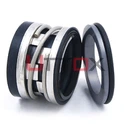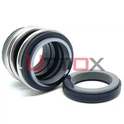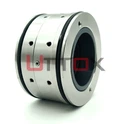


The use of mechanical seals in high pressure vessels is much more difficult than in medium and low pressure vessels, mainly due to the high pressure. If it encounters large diameter and high temperature under high pressure, it will be more difficult. Under high temperature, the material is prone to plastic deformation, and even creep, the tightening bolt will loosen, and it is easy to leak. Undoubtedly, when designing the overall structure of the high-pressure vessel, we must first consider reducing the diameter of the sealing port as much as possible, select materials that are difficult to loosen and deform at the design temperature and have good strength, and then reasonably select an appropriate sealing structure, so as to obtain reliable sealing. seal.
Mechanical Sealing Technology for High Pressure Vessels, from the sealing principle and sealing structure, the general principles are as follows:
1.Metal gaskets are generally used, and the specific pressure on the high-pressure sealing surface greatly exceeds the sealing specific pressure of medium and low pressure containers, and non-metallic gasket materials cannot achieve such a large sealing specific pressure. Commonly used metal gaskets for high pressure vessels are annealed aluminum, annealed copper or mild steel with good ductility.
2. Narrow face seals are used, and sometimes even narrow face seals are evolved into line contact seals.
3. Use medium pressure as much as possible to achieve self-tightening seals, because self-tightening seals are more reliable and compact than forced sealing.
There are many types of high-pressure seals, which are divided into two categories: forced seals and self-tightening seals according to their working principles. Forced sealing relies on the pre-tightening force of the connector (bolt) to ensure a certain contact pressure between the top cover of the pressure vessel, the sealing element and the end of the cylinder to achieve the purpose of sealing. Self-tightening sealing means that as the operating pressure in the pressure vessel increases, the contact pressure between the sealing element, the top cover, and the end of the cylinder also increases, thereby realizing the sealing effect. The characteristics of self-tightening seals are that the higher the pressure, the greater the pressing force of the sealing elements between the contact surfaces, and the better the sealing performance. When the operating conditions fluctuate, the sealing is still reliable, but the structure is more complicated and the manufacturing is more difficult. Self-tightening seals can also be divided into axial self-tightening seals and radial self-tightening seals according to the deformation of the sealing element.
According to the properties of the sealing material, high-pressure seals can be divided into plastic seals that cause plastic deformation of the sealing element and elastic seals that cause elastic deformation of the sealing element.
At present, the commonly used mechanical seals for pressure vessels include flat gasket seals and Kazari seals; semi-self-tightening seals include double cone seals; self-tightening seals include wedge seals, Wood seals, hollow metal O-ring seals, C-ring seals, B Ring seal, triangular pad seal, octagonal pad seal, flat pad self-tightening seal and rubber O-ring seal, etc.
In the appendix of the national standard for steel pressure vessels in my country, several commonly used mechanical seals structures are recommended based on experience and structural characteristics, which can be reasonably selected in combination with operating conditions during design.