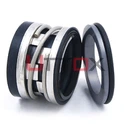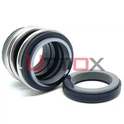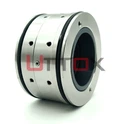


In recent years, with the continuous improvement of process parameters in petroleum, chemical, petrochemical and other industrial sectors, there are also more requirements for mechanical seals and their auxiliary measures that operate under high pressure, high temperature, volatile, corrosive, medium containing solid particles and high speed. high demands.
High temperature fluid mechanical seal In the mechanical seals, due to the continuous increase of the fluid temperature, the wear and corrosion of the seal will be accelerated, the seal ring will be easily deformed, the rubber will be aged, and the combination of the ring will be loose, resulting in leakage. In petrochemical and oil refining plants, medium and high pressure hot water pumps and boiler feed pumps have gradually adopted mechanical seals for pumps.
Mechanical seals for pumps used under special working conditions: The dynamic and static ring seats of mechanical seals are made of titanium metal, and their linear expansion coefficient is small, similar to that of tungsten carbide, and it is easy to fix the dynamic and static rings. The PTFE V-shaped sealing ring is used to ensure the followability of the auxiliary sealing ring and the dynamic and static rings at the working temperature. The outlet liquid cooler is adopted, and the cooling high-pressure liquid is sent to the shaft seal box for flushing. The structure is simple and self-flushing is adopted. Due to the use of a flushing liquid cooler, the auxiliary seal is guaranteed to be within the allowable working temperature range of PTFE, and the problem of high-temperature auxiliary seal is solved.
In petrochemical and oil refining units, it is used for column bottom thermal oil pump, heat carrier pump, oil slurry pump, residual oil pump, wax oil pump, asphalt pump, molten sulfur and plasticizer for high temperature medium such as hot oil, heat carrier and oil slurry. The chemical pump also adopts the mechanical seals for pumps.
In the high temperature oil pump, the mechanical seal problem of the low-pressure vacuum tower bottom hot oil pump containing solid particles can be solved by using a hard-to-hard seal pair. When the temperature exceeds 250 °C, the welded metal bellows mechanical seals is used. Sealing materials require heat treatment for stability. Using a single face seal requires adequate cooling and flushing. The use of double-end seals requires external isolation fluid. In order to improve the life of the auxiliary seal ring, a cooling jacket is provided on the seal on the side in contact with the medium. Using the 104 type single spring rotary mechanical seal of the series product, the carbon graphite static ring is changed to tungsten carbide, and the sealing pair of tungsten carbide and tungsten carbide is used, and the effect is very good. This kind of seal adopts metal bellows instead of spring and auxiliary sealing ring, which doubles as elastic element and auxiliary sealing element, which solves the difficult problem of auxiliary sealing under high temperature and ensures stable sealing operation. The bellows seal itself is a partially balanced seal with flushing fluid at low (negative) pressure. The bellows seal has the ability to withstand negative pressure and evacuation; under high pressure, the bellows can work normally within the pressure limit, so it has a wide range of applications. The steam back cooling measures are used to warm up the machine before starting and cool down during normal time to reduce the rapid temperature change and temperature difference, and at the same time, it can wash the sediments in the dynamic and static rings, wash the condensate, and prevent the fire when the leakage is serious. The use of static structure can avoid heat generation due to high-speed stirring for high-viscosity liquids. Adopt double metal bellows. It can maintain a low elastic constant and can withstand high pressure. Under low pressure, the outer layer wears out, and the inner layer still works. The use of double-layer metal bellows has good elasticity. When using, care must be taken that the bellows seal will fail due to deposition or coking around the bellows due to changes in operating conditions.